The New Mandate for Enterprise AI
Artificial Intelligence holds immense promise for the enterprise, yet its adoption is stalled. While the market promotes a compelling fantasy of autonomous "AI Agents" poised to revolutionize operations, leaders grapple with a starkly different reality: the non-negotiable imperative for governance, reliability, and accountability.
This disconnect isn't just slowing AI adoption; it's creating a significant, unmanaged risk.
The "Agent" Hype vs. The Accountability Imperative
Today's dominant narrative, focused on maximizing AI autonomy, is a strategic trap. It overlooks the fundamental nature of enterprise systems, where predictability, auditability, and control are paramount. An AI system that operates as an ungoverned "black box," however clever, is not an asset; it is a potential compliance, security, and financial liability waiting to happen.
The real bottleneck isn't the technology's capability, but the lack of organizational confidence stemming from this accountability gap.
Thesis: Autonomy Is a Liability. Accountability Is the Asset.
This paper argues for a critical shift in perspective: the primary goal of enterprise AI is not achieving maximum autonomy, but ensuring total accountability. Uncontrolled autonomy introduces unacceptable risk. True, sustainable value is unlocked only when AI systems are architected from the ground up to be transparent, auditable, and reliably governed.
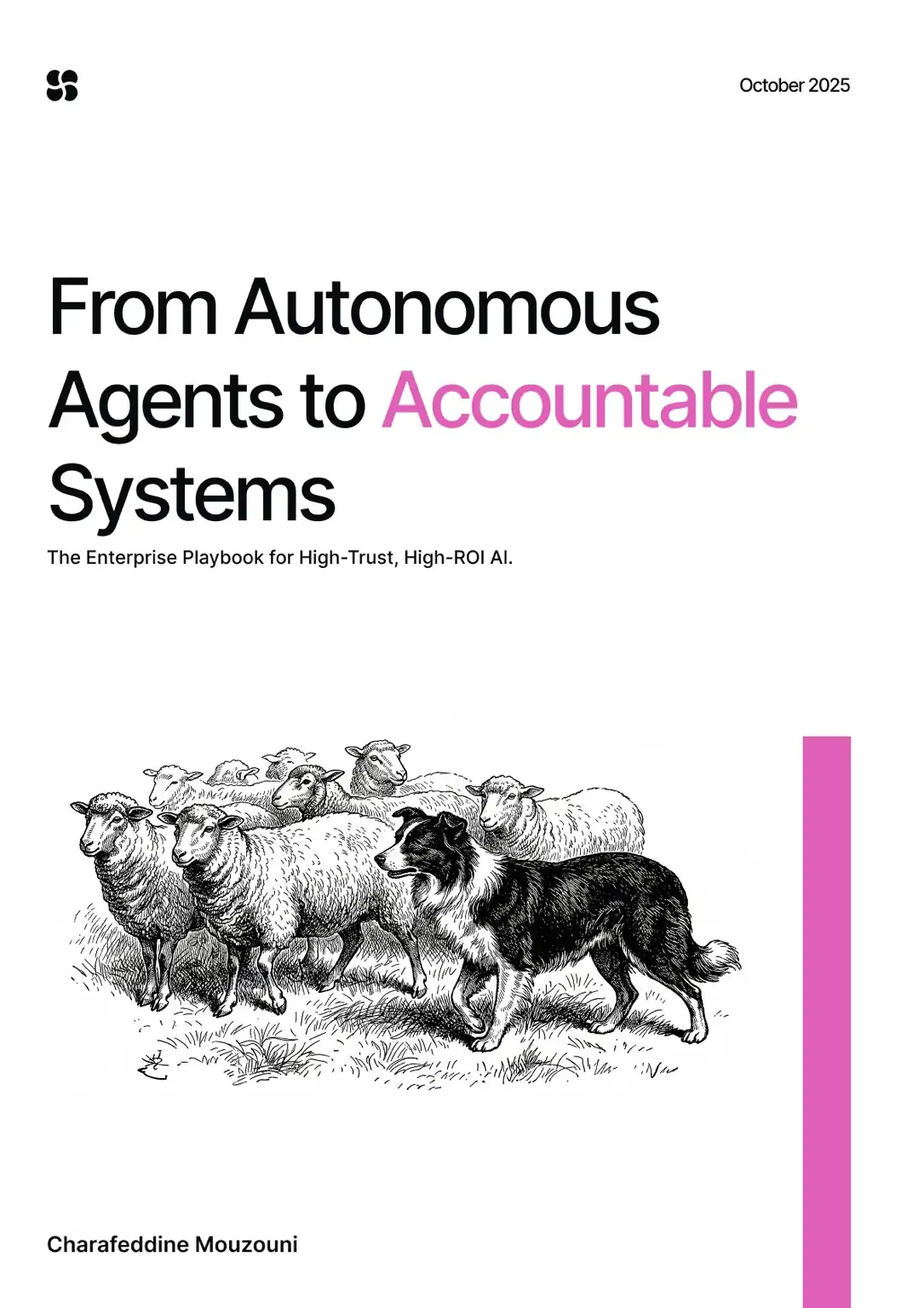
Accountability isn't a brake on innovation; it's the steering and braking system that makes innovation safe and scalable.
The AI "Fantasy" vs. Reality
Today's executive is caught between two opposing narratives.
The first is the "Agent Fantasy": a market-driven vision of "autonomous" AI agents that promises self-directing "armies of agents" executing complex business functions with minimal human oversight. This vision sells a compelling, almost magical solution.
The second is the "Enterprise Reality": a pragmatic world governed not by potential, but by process. This reality is defined by non-negotiable requirements for security, compliance, auditability, and resilience. In this world, a 1% error rate is not a statistical achievement; it is a critical failure that could result in a compliance breach, data leakage, or catastrophic loss of customer trust.
A 3-Step Playbook for Enterprise Leaders
This playbook provides a pragmatic, 90-day roadmap for beginning this journey:
- Identify & Audit (Days 1-30): Select one high-ROI, low-risk internal "Augmentation" use case and conduct a targeted audit to identify critical governance gaps.
- Architect the Foundation (Days 31-60): Build the minimum viable AI OS components (governance, security, initial tooling gateway) needed to close those gaps.
- Deploy & Validate (Days 61-90): Launch the first accountable AI system on the new platform, implement essential monitoring, and measure the tangible ROI.
The choice is clear: continue chasing the agent fantasy, or start building the accountable systems that will define market leadership.