
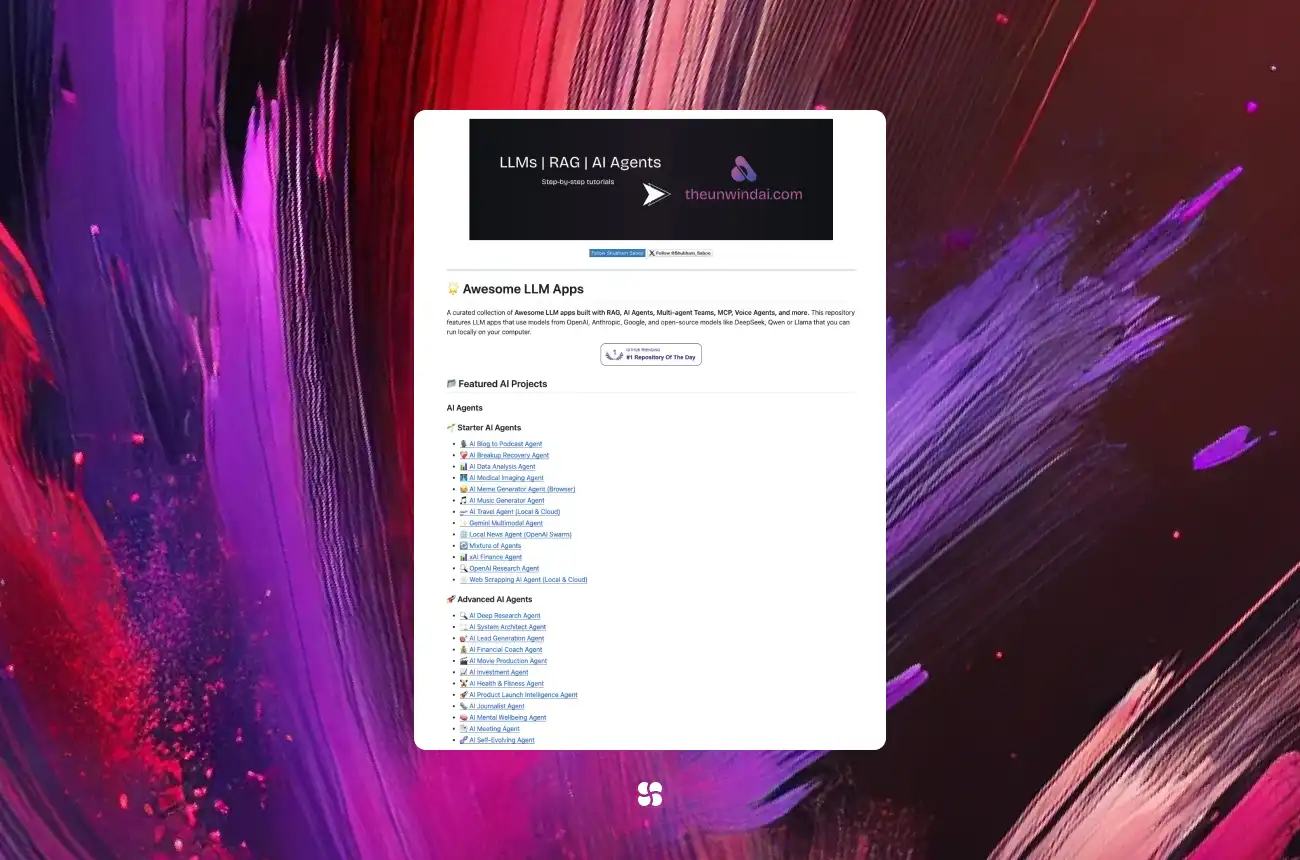
1. Why this repo is on every AI VP’s reading list
- Breadth. 75 + runnable examples cover the entire agent/RAG stack: single-agent toys, production-grade multi-agent teams, voice pipelines, MCP (Model-Control-Protocol) integrations, and every popular LLM provider. github.com
- Depth. Each folder is a mini-tutorial with
requirements.txt, fully-commentedmain.py, and step-by-step READMEs—ideal for architecture reviews or onboarding new hires. github.com - Community proof. ~35 k GitHub stars (and counting) signal active maintenance and real-world adoption. github.com
2. Cloning & first run (5 min)
git clone https://github.com/Shubhamsaboo/awesome-llm-apps.git
cd awesome-llm-apps/starter_ai_agents/ai_data_analysis_agent
python -m venv .venv && source .venv/bin/activate      # optional isolation
pip install -r requirements.txt
python main.py --csv /path/to/marketing_funnel.csv
Inside main.py you’ll see a ReAct-style loop: the LLM writes pandas code, the sandbox executes it, results go back to the LLM for reflection. Swap in Snowflake or DuckDB by replacing the run_code() helper.
3. Tour of the jungle — what lives where
| Folder | What you’ll learn (2-sentence pitch) |
|---|---|
| starter_ai_agents/ | Single-agent patterns: prompt-only blog-to-podcast TTS, a one-file Meme Generator that puppets a headless browser, Gemini multimodal demo for doc + image reasoning. |
| advanced_ai_agents/ | Tool-using planners: Deep Research Agent chains web-search → notebook auto-summaries; System Architect Agent outputs PlantUML and tests. |
| autonomous_game_agents/ | Pygame, Chess, and Tic-Tac-Toe bots showcasing event-loop reflection and self-play evaluation. |
| multi_agent_teams/ | CrewAI orchestration with dynamic role assignment—for instance, Competitor Intel spawns “Researcher”, “Analyst”, “Writer” workers. |
| voice_ai_agents/ | Real-time streaming with OpenAI TTS ↔︎ Whisper; Customer-Support Voice Agent shows slot-filling plus sentiment escalation. |
| mcp_ai_agents/ | Browser, GitHub, Notion, and Travel MCP demos—agents can read/patch external state through the Model Control Protocol. |
| rag/ | From “Basic Chain” to Autonomous RAG with self-reflection plus CRAG (Corrective RAG) that re-issues queries when confidence drops. |
(Folder names are verbatim; open any README for wiring diagrams and API keys.) github.com
4. Deep-dive playbook
Below are cut-down excerpts you can paste into a scratch repo to feel each pattern.
4.1 Starter: AI Data Analysis Agent
from langchain.agents import create_pandas_dataframe_agent, load_tools
from langchain.chat_models import ChatOpenAI
import pandas as pd

df = pd.read_csv("marketing_funnel.csv")
llm = ChatOpenAI(model_name="gpt-4o-mini", temperature=0)

agent = create_pandas_dataframe_agent(
    llm, df,
    tools=load_tools(["python"])
)

question = "Which channel had the lowest CAC in Q1 2025?"
print(agent.run(question))
Why it matters: zero-shot spreadsheet analysis becomes safe—code executes in a jailed interpreter and results feed back for validation.
4.2 Advanced: Deep Research Agent
Key architecture:
- Task Decomposer → splits a query into sub-topics.
- Retriever Tool (SerpAPI + scholarly) → fetches sources.
- Writer → consolidates using a source-grounded prompt.
- Critic → runs an “alarm” chain; if hallucination probability > 25 %, loop back.
flowchart TD
    Q(User) --> Decompose
    Decompose -->|sub-q| Search
    Search --> Draft
    Draft --> Critic
    Critic -->|ok| Answer
    Critic -->|revise| Search
Swap out any node—e.g., plug VectorDB into Retriever for private corp data.
4.3 Multi-agent: Competitor Intelligence Team
from crewai import Agent, Crew, Task
from tools import GoogleSearch, PDFReader

researcher = Agent("Researcher", tools=[GoogleSearch()])
analyst    = Agent("Analyst",   tools=[PDFReader()])
writer     = Agent("Writer")

tasks = [
    Task(researcher, "Gather recent funding news on ACME Corp"),
    Task(analyst,    "Extract valuation multiples & growth metrics"),
    Task(writer,     "Draft a 1-page brief with charts")
]

Crew(tasks).run()
Pro tip: orchestrate via event bus (Redis pub/sub). Your VP of Product can subscribe to milestone events without reading every token.
4.4 RAG pattern: Self-Correcting RAG (CRAG)
from langchain.chains import ConversationalRetrievalChain
from langchain.retrievers import SelfQueryRetriever

vector = SelfQueryRetriever.from_llm(
   llm=ChatOpenAI(),
   vectorstore=my_chroma,
   metadata_field="confidence"
)

rag = ConversationalRetrievalChain.from_llm(
   ChatOpenAI(),
   retriever=vector,
   refine_strategy="force_new_search_if_confidence_below:0.2"
)
When confidence drops, the retriever auto-re-queries with an expanded Boolean expression—no extra glue code.
5. Shipping to prod
| Concern | Cheat-sheet |
|---|---|
| Local vs Cloud | All demos run on CPU; add --model qwen:4b-int4 for Ollama or replace with OpenAI endpoints. |
| Observability | Wrap agent.run() in LangSmith or Helicone; repo includes ready-made JSON logging hooks. |
| Security | Use the MCP Browser agent to enforce domain allow-lists; for RAG, enable strict source quoting to avoid prompt-injection. |
| Scaling | For multi-agent crews, stick a simple priority queue (Redis/ZMQ) in front and deploy workers as Kubernetes jobs. |
6. Extending the repo (your next PR)
- Pick a blank slot under the right folder.
- Fork, branch, copy the
template_project/scaffold. - Update
README.md—keep the Getting Started section consistent. - Test with
pytest -q(yes, each tutorial has smoke tests). - Open a PR with a 30-sec Loom demo link; maintainers merge fast.
Happy hacking!
Tega AdeyemiJune 12, 2025