
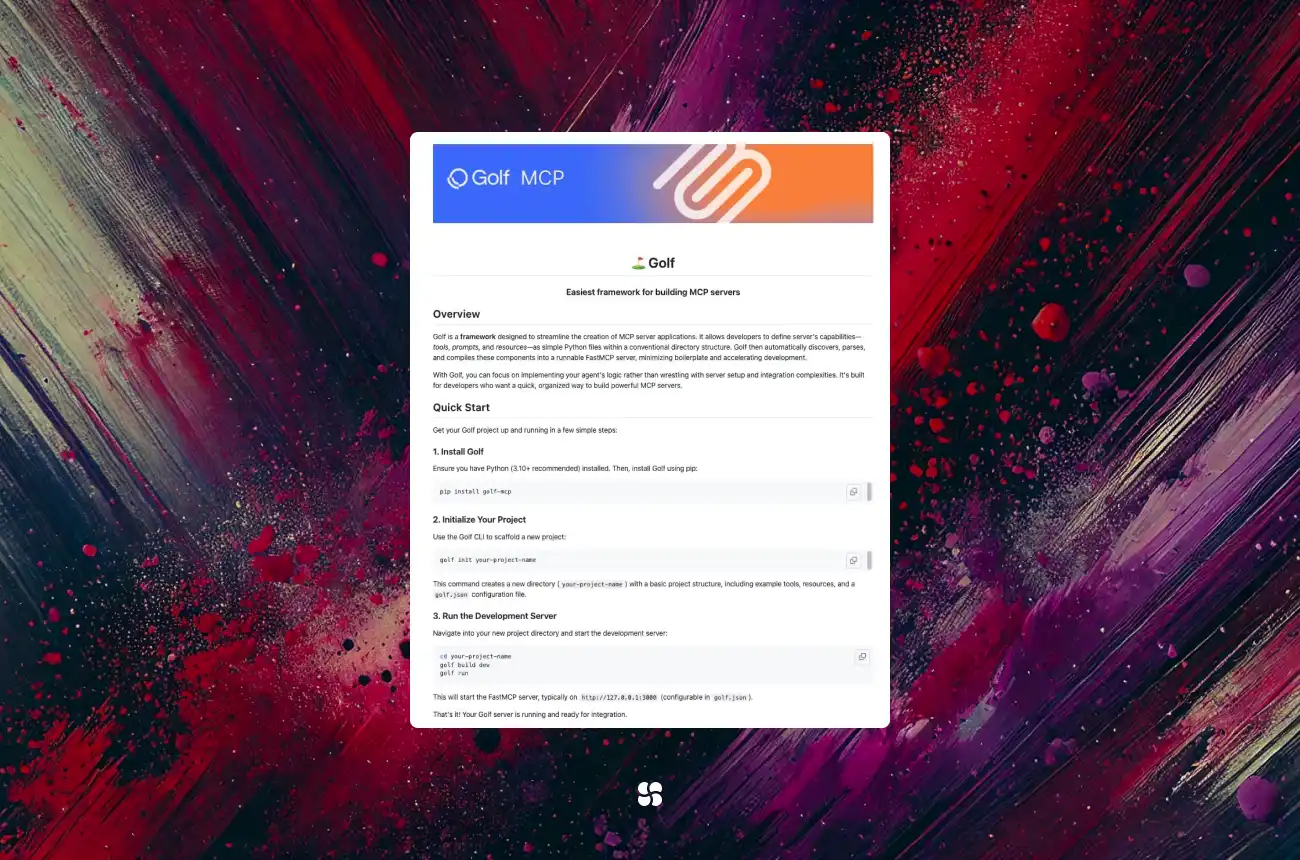
Golf is a no-frills, Python-first framework that turns a folder full of tools, prompts, and resources into a fully-functioning FastMCP server with built-in auth, observability, and a one-command build pipeline. If you can write an async def you can ship an MCP server before your morning espresso. We’ll install it, build a sample tool, wire it up to the OpenAI Agents SDK, and pit it against TypeScript-based MCP Framework and managed offerings like Composio MCP and PulseMCP.
1. What Exactly Is Golf?
Think of Golf as the “Rails-for-agents” layer that sits outside the MCP spec: it handles project scaffolding, routing, transport selection (SSE, Streamable HTTP, STDIO), auth, and telemetry so you only write the business logic.
On first run Golf scans your tools/, prompts/, and resources/ directories, auto-generates the MCP schemas, and spins up a FastAPI-based FastMCP server—no JSON schema hand-crafting, no YAML incantations.
Behind the scenes the CLI captures anonymous usage metrics (command name, success/failure) and sends them home unless you golf telemetry disable—a nice balance between product feedback and privacy.
2. Why Developers (and AI VPs) Care
| Pain-killer | What Golf Gives You | Business Impact |
|---|---|---|
| Setup overhead | golf init my-project scaffolds a full server in <5 sec |
Faster prototypes → quicker market validation |
| Boilerplate fatigue | Auto-discovery of tools/resources | Engineers focus on features, not glue code |
| Observability gaps | OpenTelemetry baked in (opentelemetry_enabled: true) |
VP gets traces in Grafana without extra tickets |
| Deployment drama | Road-mapped golf deploy (Vercel, Blaxel) |
One-click prod pushes (coming soon) |
| Spec churn | Tracks latest MCP transports (SSE, Streamable HTTP) | Future-proof against protocol changes |
3. Five-Minute Quick Start
“Let’s get a server running before this paragraph ends.”
# 1. Install the CLI
pip install golf-mcp        # Python 3.10+

# 2. Scaffold
golf init hello-golf
cd hello-golf

# 3. Run in dev mode
golf build dev
golf run           # => http://127.0.0.1:3000
Golf drops a project tree like:
hello-golf/
├─ golf.json
├─ tools/
│  └─ hello.py
├─ prompts/
├─ resources/
└─ .env
Writing Your First Tool
# tools/hello.py
"""Greet a user."""

from typing import Annotated
from pydantic import BaseModel, Field

class Output(BaseModel):
    message: str

async def hello(
    name: Annotated[str, Field(description="Who to greet")] = "World",
    greeting: Annotated[str, Field(description="Greeting phrase")] = "Hello",
) -> Output:
    print(f"{greeting}, {name}!")
    return Output(message=f"{greeting}, {name}!")

export = hello   # Golf’s discovery flag
Restart the dev server and the tool is instantly live under the MCP ID hello.
4. Deep-Dive Features You’ll Actually Use
4.1 Observability
Flip a switch in golf.json:
{
  "opentelemetry_enabled": true,
  "opentelemetry_default_exporter": "otlp_http"
}
…and Golf traces every tool invocation, prompt render, and HTTP hop. Swap Jaeger or Tempo endpoints via OTEL_EXPORTER_OTLP_ENDPOINT.
4.2 Transport Flexibility
- SSE – great for web clients
- Streamable HTTP – follows the 2025-03-26 MCP spec for chunked responses
- STDIO – spawn your server as a subprocess for local IDE integrations
4.3 Road-map Goodies
golf deploy promises one-command pushes to Vercel & friends, plus encrypted OAuth token storage for long-running agents. VP-level peace of mind.
5. From Local to Agent: Golf × OpenAI Agents SDK
from openai_agents_python.mcp import MCPServerSse
from agents import Agent

# 1. Point the SDK to your Golf server
golf_server = MCPServerSse(url="http://127.0.0.1:3000", cache_tools_list=True)

# 2. Wire into an agent
agent = Agent(
    name="Assistant",
    instructions="Use the MCP tools to get stuff done",
    mcp_servers=[golf_server],
)

response = await agent.run("Say hello to the CFO")
print(response)
The SDK auto-lists Golf’s tools and lets the LLM call them with zero extra glue.
6. How Does Golf Stack Up?
6.1 Golf vs MCP Framework (TypeScript)
| Feature | Golf (Python) | MCP Framework (TS) |
|---|---|---|
| Language | Pythonic async | Full TypeScript |
| Quickstart | pip install + golf init |
npm i -g mcp-framework + mcp create |
| Auth | Planned OAuth store | JWT/API-key out-of-box |
| Dev velocity | Pydantic schemas auto-generated | zod schema explicit |
| Community size | 300+ stars | Early but growing |
| Ideal for | Data-science teams, Python shops | Front-end + Node ecosystems |
6.2 Golf vs Composio MCP (Managed SaaS)
| Golf | Composio MCP | |
|---|---|---|
| Hosting | Self or BYOC | Fully-managed, white-label servers with built-in auth |
| Tool catalog | Whatever you build | 250+ pre-built tools (Gmail, Linear, etc.) |
| Pricing | OSS (Apache-2.0) | Usage-based SaaS |
| Control | Full code ownership | Vendor lock-in trade-off |
6.3 Golf vs PulseMCP / Registries
- PulseMCP & peers (Smithery, MCP.so) are discovery layers—think “npm for MCP servers.” They complement, not replace, Golf.
- You can publish your Golf server to any registry once
golf deploylands.
7. Production Checklist
- Containerize: Drop your build into a slim Python 3.12-alpine image; follow the Snyk hardening tips for MCP servers-in-Docker.
- Rate-limit: Front your server with an API gateway; Golf’s upcoming deployment helper will expose per-tenant throttles.
- Observability budget: Export OTLP traces to Grafana Tempo; log volumes add up quickly.
- Token hygiene: If you roll your own OAuth, encrypt at rest—don’t wait for the roadmap.
8. Best Practices & Pro Tips
- Module docstrings == tool descriptions – keep them crisp; they surface directly in agent UIs.
- Group domain logic under sub-folders (
tools/payments/charge.py)—Golf turns path segments into hyphen-delimited IDs, preventing name collisions. - Cache tool lists on the client (
cache_tools_list=True) to shave latency in chat loops. - Humor-driven logging: sprinkle a witty log message—debugging at 2 a.m. needs comic relief.
9. Conclusion – Should You Swing With Golf?
If your stack is Python, you want full control, and you value time-to-MCP over having 250 ready-made SaaS integrations, Golf is a hole-in-one. For TypeScript shops, MCP Framework feels more native. Need off-the-shelf Gmail, Sheets, and HubSpot? Composio MCP is turnkey. The beauty of MCP’s plug-and-play ethos is that you can mix-and-match: prototype in Golf, then bolt on Composio servers as business needs grow.
Whichever fairway you choose, may your tests be green and your logs free of sand-trap stack traces.
Tega AdeyemiMay 26, 2025