
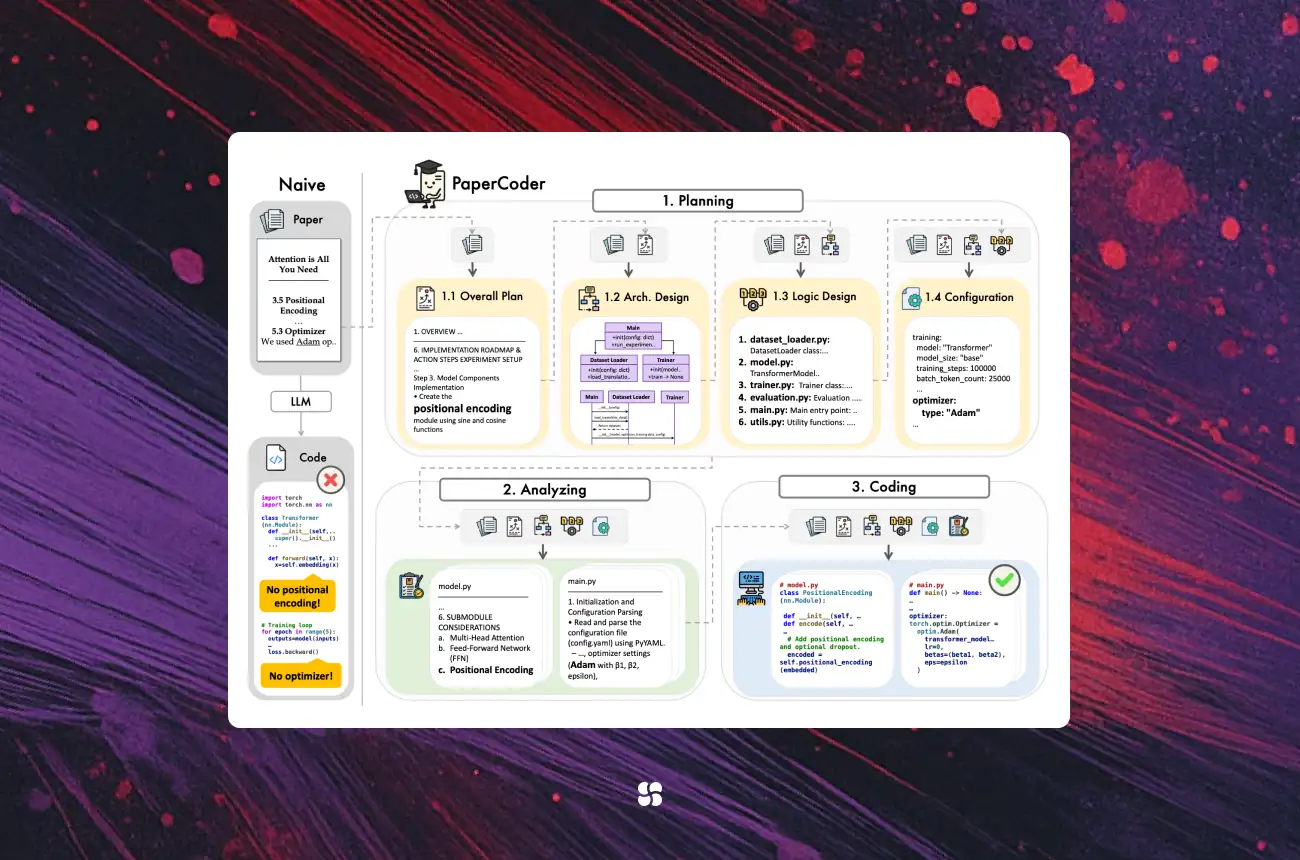
Paper2Code (aka PaperCoder) is an open-source, multi-agent LLM framework that automates the transformation of machine-learning papers into fully functional code repositories. It works in three stages—planning, analysis, and code generatio—each orchestrated by specialized agents. With strong performance on benchmarks like PaperBench and Paper2Code, it delivers high-quality, faithful implementations that often “just work” with minimal tweaking. Whether you’re a hands-on developer or an AI exec looking for faster R&D cycles, Paper2Code can shrink weeks of manual effort into hours of automated magic.
What Is Paper2Code?
At its heart, Paper2Code is a pipeline that reads a paper, plans the project structure, digs into implementation details, then spits out a ready-to-run codebase.
- It’s powered by LLMs (e.g., OpenAI’s o3-mini or open-source vLLM models) in a multi-agent setup .
- The repo on GitHub boasts over 1.3 k stars, scripts, examples, and a benchmark dataset on Hugging Face .
Think of it as your own AI grad student that never tires, never demands ramen, and never accidentally deletes the main branch.
How It Works
Paper2Code’s pipeline splits into three intuitive phases:
1. Planning
- Roadmap creation: Drafts file/folder structure, config files, and even UML-style diagrams.
- Dependency graph: Figures out which modules talk to which.
“Hey PaperCoder, give me the lay of the land before we build!”
2. Analysis
- Deep dives: Parses method sections, equations, and algorithmic constraints.
- Function specs: Determines inputs, outputs, and inter-module calls.
It’s like having a PhD student who actually reads the fine print and asks the right questions .
3. Code Generation
- Module-by-module construction: Writes code in the correct order, respects dependencies, and uses best practices.
- Modular output: Delivers a full repo—tests, README, scripts—ready to clone, install, and run.
“npm install, python main.py, voila!”
Why Developers & AI Leaders Should Care
- Reproducibility Boost
- 77 % of generated repos are rated “best” by human judges; 85 % say they’re helpful .
- Speed & Scale
- Spin up implementations in hours vs. weeks. Especially handy when you’re chasing hot new papers at a deadline .
- Governance & Compliance
- C-level relief: standardized codebases reduce risk of “shadow implementations” and ensure reproducibility across teams .
- C-level relief: standardized codebases reduce risk of “shadow implementations” and ensure reproducibility across teams .
VP of AI: “So you’re telling me our teams can go from paper to POC in one coffee break?”
Paper2Code: “Exactly. Minus the jitteriness.” ☕️
Quick-Start Example
Clone, install, and run on “Attention Is All You Need” in minutes:
# 1. Install dependencies
pip install openai vllm

# 2. Set your API key
export OPENAI_API_KEY="YOUR_KEY"

# 3. Run PaperCoder
cd scripts
bash run.sh   # uses PDF-to-JSON behind the scenes

# Output lands in outputs/Transformer_repo
ls outputs/Transformer_repo
Best Practices & Tips
- Paper Quality Matters: Clear LaTeX source yields fewer parsing hiccups.
- Agent Tuning: For bleeding-edge research, experiment with larger LLMs or domain-specific fine-tuning.
- Error Handling: Occasionally you’ll need a one-line fix (avg. 0.48 % of lines) to resolve execution errors .
Pro Tip: Treat the generated code as a “90 % done” scaffold—review tests and edge cases before productionizing.
Potential Impact & Future Directions
- Beyond Text: Look for multimodal extensions (e.g., AutoP2C) that parse figures and tables directly .
- Community Sharing: Envision a GitHub marketplace of auto-generated repos for every new preprint.
- Hallucination Guardrails: Ongoing work aims to tighten specification compliance and reduce “creative” code wrong turns .
Conclusion
Paper2Code transforms the tortoise-slow paper-to-code journey into a hare-fast sprint. By automating planning, analysis, and generation, it empowers developers and AI leaders to focus on innovation, not boilerplate. Give it a spin on your next research dive—your future self (and your sanity) will thank you.
Get started: GitHub → Paper2Code
Read the paper: arXiv:2504.17192
Happy coding!
Tega AdeyemiMay 6, 2025