
1. Why “memory” matters—even for stateless APIs
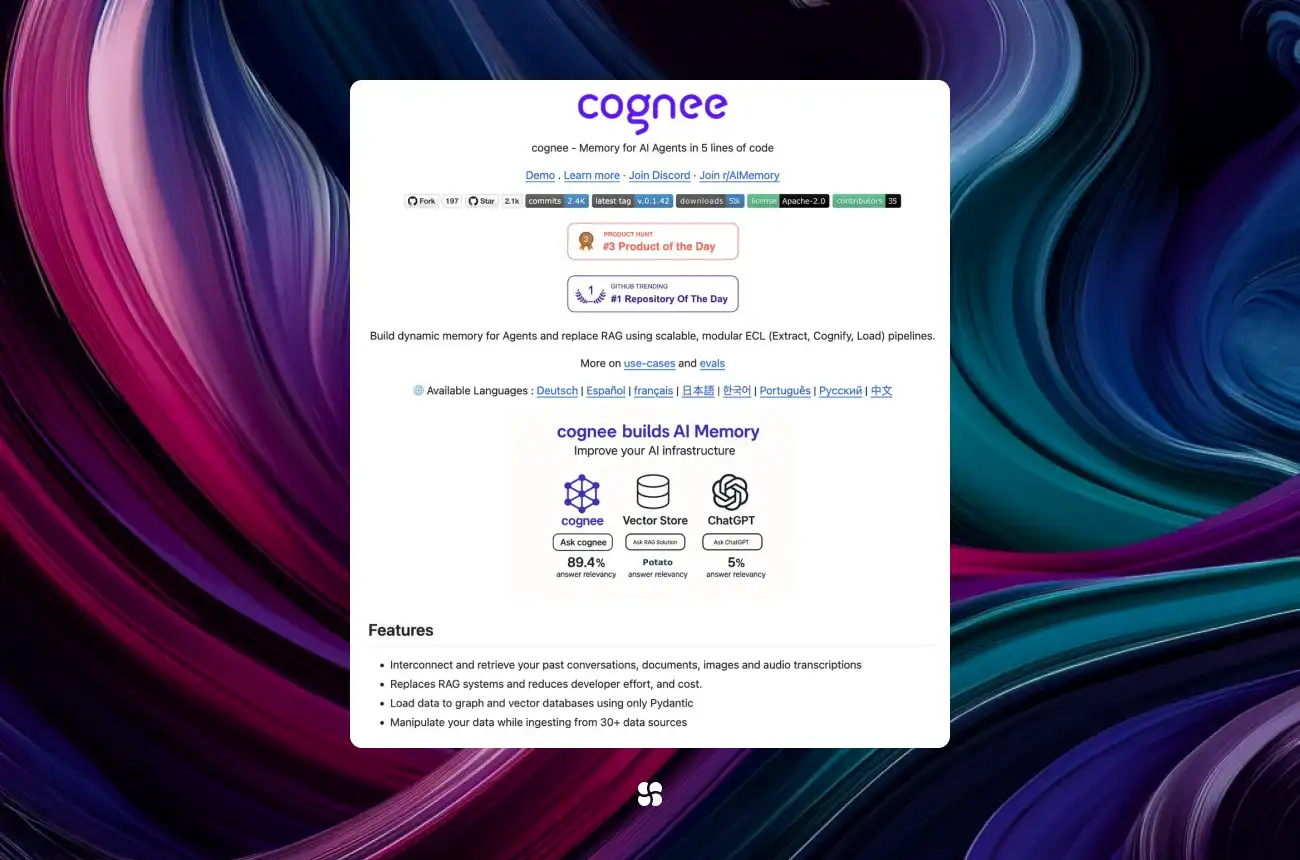
Large-language-model apps feel magical until users ask a follow-up question and the model stares back like a goldfish. Cognee fixes that goldfish-brain by giving your agents a first-class, queryable memory layer—documents, calls, images, audio transcripts, the lot—while keeping the ergonomics down to a handful of lines.
Agent memory is a context-engineering problem; designing what to remember, when to retrieve, and how to evaluate it is the focus of Cohorte's Context Architecture course (E5).
2. Under the hood: E → C → L pipelines
Cognee structures everything as ECL pipelines:
| Step | What happens |
|---|---|
| Extract | Split raw text & media into chunks and metadata |
| Cognify | Call an LLM to enrich, generate a knowledge graph, add embeddings |
| Load | Persist to your chosen vector + graph stores |
Because each step is a reusable task, you can remix them or insert custom logic without rewiring the whole stack. github.com
3. Quick-start in 90 seconds
# 1 – install
pip install cognee

# 2 – set credentials
export LLM_API_KEY=sk-...

# 3 – code!
import cognee, asyncio
async def main():
await cognee.add(
"Natural language processing (NLP) is an interdisciplinary subfield of computer science."
)
await cognee.cognify()
print(await cognee.search("Tell me about NLP"))
asyncio.run(main())That’s literally the “hello world” from the repo—and yes, it prints back a tidy explanation of NLP. github.com
4. Storage & runtime options
| Layer | Default | Other options (just pip install 'cognee[option]') |
|---|---|---|
| Vector DB | LanceDB | Qdrant · PGVector · Weaviate |
| Graph DB | NetworkX | Neo4j |
| LLM provider | OpenAI | Anyscale · Ollama |
Each backend ships as an extra, so you only pull the wheels you actually need. github.com
5. A slightly fancier demo: adding an ontology
# examples/python/ontology_demo_example.py boiled down
from cognee.api.v1.search import SearchType
from cognee.api.v1.visualize.visualize import visualize_graph
...
await cognee.prune.prune_data()
await cognee.add([cars_text, tech_text])
await cognee.cognify(ontology_file_path="basic_ontology.owl")

graph_answer = await cognee.search(
    SearchType.GRAPH_COMPLETION,
    "What cars and their types are produced by Audi?"
)
visualize_graph()
In ~20 lines we: reset memory, load two paragraphs, fuse them with an OWL ontology, then complete a graph query. Try that in vanilla RAG and watch the boilerplate grow. github.com
6. Using Cognee inside LangChain (if you really can’t quit the Chain)
from langchain_cognee.retrievers import CogneeRetriever
retriever = CogneeRetriever(llm_api_key="KEY", dataset_name="project-x", k=3)

retriever.add_documents([
    Document(page_content="Elon Musk is the CEO of SpaceX."),
    Document(page_content="SpaceX builds rockets."),
])
retriever.process_data()          # builds the graph
for doc in retriever.invoke("Tell me about Elon Musk"):
    print(doc.page_content)
Same graph-first semantics, now drop-in compatible with the LangChain ecosystem.
7. How Cognee compares (briefly, promise)
- Classic RAG toolkits (pure vector search) give you cosine-similarity chunks; Cognee fuses vector + graph so you can ask for explicit relationships (“Which suppliers relate to battery tech and have ISO-9001?”).
- Knowledge-graph frameworks (Neo4j-only stacks) excel at structure but stumble on fuzzy similarity; Cognee bundles both stores and lets you choose the backend.
- Agent libraries often leave “memory” to a key-value cache; Cognee’s memory is persistent, multi-modal, and permission-aware.
(Yes, the repo literally says it “replaces RAG systems”—we’re just reading the docs.)
Cognee handles the store. What it does not decide is who may write to it, with what evidence, and how you take a memory back. AI agent memory architecture: governed writes, not storage covers the promotion gate that sits in front of any memory framework.
8. Production pointers & best practices
- Start local: LanceDB + NetworkX run in-process, perfect for dev containers.
- Gradually externalise: swap in Qdrant/Neo4j when latency & multi-node access matter.
- Prune aggressively in tests (
cognee.prune.*)—the graph grows fast. - Split pipelines: run extraction async at ingest time, cognition lazily when queries hit spike.
- Visualise early:
visualize_graph()saves hours of “why is my edge missing?” debugging.
9. TL;DR for the busy VP
- 5 lines to a working, queryable memory.
- Graph + Vector unified, pluggable backends.
- ECL pipelines keep ops transparent and auditable.
- Ships with LangChain integration, CLI, and a local UI.
- Apache-2.0; latest tag v0.1.42 (Jun 7 2025)—yes, it’s alive.
“Give your agents something better than a goldfish memory—with Cognee they’ll remember the conversation and draw you a knowledge graph of it.”
Happy hacking, and may your embeddings always find the shortest path!
Tega AdeyemiJune 10, 2025